

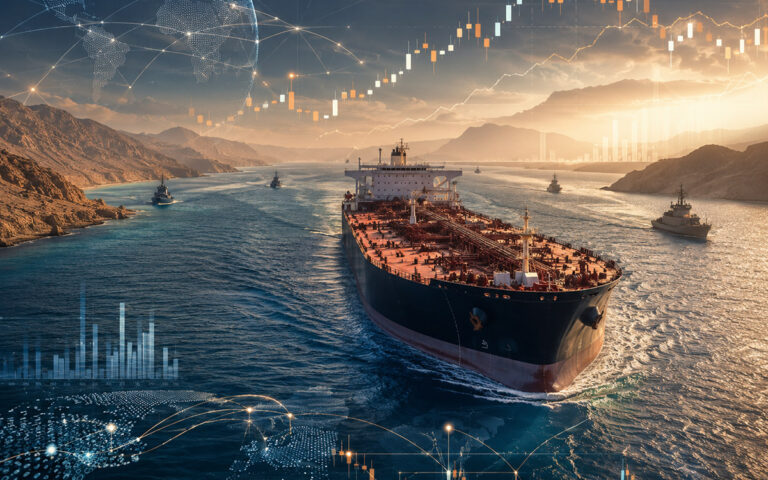
Antoine Souma has spent recent months studying a real-time lesson in how modern risk actually travels, and it has little to do with tanks or missiles. As founder of Galliott Capital Advisors, an independent boutique wealth advisory and extended family office serving entrepreneurs and multigenerational families, he has built his practice around helping clients recognize risk before it becomes a headline.
The prolonged closure of the Strait of Hormuz, the waterway that historically carries roughly a fifth of the world’s oil, offers what he considers one of the clearest case studies in years of how quickly global capital repositions once a threat becomes real, and why families holding wealth across borders need to be paying closer attention than most.
Understanding Chokepoint Economics and Global Risk
Geopolitical risk management has traditionally been treated as a background consideration for global investors, something to note but not necessarily to plan around. Souma views that posture as increasingly outdated. The Hormuz episode demonstrated that a strategic waterway did not need to be physically blocked to become functionally closed.
War-risk insurance premiums surged within days of the initial disruption, tanker traffic collapsed by more than eighty percent, and shipping essentially stopped, because the financial math no longer justified the crossing. Souma describes this dynamic as a defining feature of contemporary chokepoint economics where markets often price in danger faster than governments can respond to it, and that repricing carries consequences far past the immediate region.
The Insurance Signal Global Families Should Watch
“The families I work with are not watching the strait itself. They are watching what gets built to make the strait irrelevant, because that is where capital has actually been moving,” says Souma.
That distinction matters enormously for anyone managing multigenerational wealth. The headline event, in his view, is rarely the investable moment. By the time a crisis dominates news coverage, the repricing has typically already occurred, and the families who benefit most are the ones who understood the underlying vulnerability well before it became visible to a broader audience.
That vulnerability, in the Hormuz case, was focused around the fragility of relying on a single route, a single insurer class, or a single legal jurisdiction to carry an outsized share of global economic activity. Souma sees a direct parallel to how globally mobile families can structure their own affairs, frequently concentrating assets, residency, or succession planning around a single jurisdiction without fully appreciating how quickly that arrangement can become a liability once conditions shift.
Why Redundancy Is Becoming a Wealth Strategy, Not Just a Shipping Strategy
Gulf states responded to the Hormuz disruption by accelerating alternative infrastructure. Pipeline capacity expanded to record levels, new export routes were fast-tracked, and rail corridors that once seemed unnecessary suddenly became strategic priorities. Souma argues that this pattern, building redundancy before it becomes urgent, is exactly the discipline global wealth strategy should borrow.
Diversification across asset classes has long been standard practice, yet many families still underinvest in diversification across jurisdictions, currencies, and legal structures, which is precisely the kind of concentration risk that a geopolitical shock exposes without warning.
“What surprised people about Hormuz was not that a chokepoint got weaponized,” Antoine Souma explains. “It was how fast sophisticated capital moved to make sure it never depended on that chokepoint again. That same instinct belongs in how families think about their own wealth architecture.”
Portfolio Resilience for Globally Mobile Families
Family offices globally have already begun responding to this environment. Recent industry surveys show geopolitical conflict now ranks as the top concern among family offices worldwide, ahead of inflation and recession risk, prompting many to accelerate diversification across regions and currencies as opposed to concentrating exposure in any single market.
The shift may be overdue. Souma notes that the families who treat geographic and structural diversification as a standing discipline, not a reactive measure, tend to navigate disruption with far less disruption to their own plans. That discipline surpasses investment portfolios into the broader architecture of cross-border wealth.
Succession plans, trusts, and residency arrangements built around a single jurisdiction can become exposed the same way a shipping route did once insurance economics shifted. Antoine Souma urges clients to stress-test structures against what happens if the primary route becomes unusable.
Alternative Assets and the Search for Structural Stability
The search for redundancy has reshaped where sophisticated capital commits long-term. Once niche, infrastructure investment has grown into a core component of institutional and family office portfolios, offering income less correlated with public markets and greater resilience across cycles.
Souma sees growing client interest in this allocation, a natural complement to the same redundancy logic now playing out geopolitically. Transportation, energy transition, and digital infrastructure hold value precisely because the world cannot easily route around them.
“None of this means abandoning conventional strategy for reactive positioning,” Souma says. “It means recognizing the line between geopolitical events and financial events has essentially disappeared.”
A conflict abroad can now reprice risk for a distant family within days, and those best positioned built flexibility into their structures long before it happened.
Preparing for the Next Chokepoint
The Strait of Hormuz won’t be the last chokepoint to test global capital’s assumptions about efficiency versus resilience. Antoine Souma expects a broader reassessment of how much concentration, geographic, structural, or strategic, global families will tolerate in pursuit of efficiency.
Families who compound wealth through geopolitical stress are rarely the ones who predicted a single event. They’re the ones who built enough redundancy into their financial and legal architecture that no single event could threaten the whole structure.
Resilience like that takes years, not months, which is why Souma treats geopolitical risk management as an ongoing practice rather than a response to the latest crisis. Efficiency defined the last several decades of wealth strategy. Redundancy will define the next chapter, and families paying attention now will be best prepared for whatever chokepoint tests the system next.