

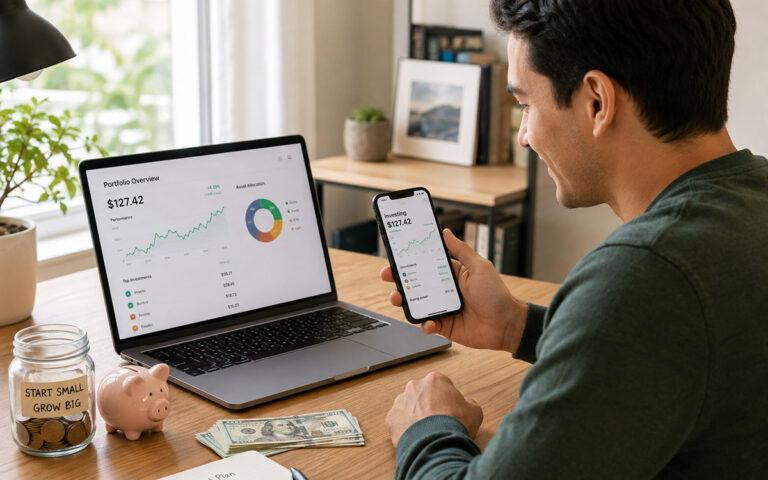
One hundred dollars is enough to start, because fractional shares now begin at $1. What matters is the order you do things in: clear high-interest debt, set aside a small cash buffer, pick the account type before the investment, put the money into one diversified fund, and then automate the next $100. The first deposit is a habit, not a windfall.
Key Takeaways
- Fractional share investing is real and verifiable: Fidelity and Schwab both let you buy pieces of stocks and ETFs for as little as $1.
- For a first $100, the account type you use matters more than the specific fund you pick.
- The 2026 IRA contribution limit is $7,500, which is far more headroom than a beginner needs.
- With the average credit card rate at 22.15% on accounts assessed interest, paying down card debt usually outranks investing.
- Automating the next $100 does more for your outcome than optimizing the first one.
Learning how to start investing with $100 used to come with an irritating answer: you can’t; come back when you have more. That answer is out of date. Fidelity now sells fractional shares of stocks and most ETFs for as little as $1, with zero account minimums and zero account fees to open a retail brokerage account. Schwab’s Stock Slices work on the same principle, giving you a piece of most U.S.-listed stocks and ETFs starting at $1, with no commissions on online trades.
So the price of a single share is no longer the obstacle. The obstacle is sequence. What you do with the first $100—and, more importantly, with the next one—decides whether the investment becomes a habit or a screenshot you look at once and forget.
This guide walks through that sequence using only figures that can be checked: current IRS contribution limits, published broker terms, and Federal Reserve data on what debt costs right now.
One thing before we start. This article is financial education, not financial advice. It cannot see your income, your tax situation, your job security, or how you would feel watching a balance fall. Use it to understand the mechanics, and then make your own decision.
1. Can You Really Start Investing With $100?
Yes. Fractional shares mean a $100 balance can buy a slice of a diversified fund instead of sitting in cash while you wait for a share price to fall. Both Fidelity and Schwab set the floor at $1, so $100 is a real position, not a rounding error.
The old barrier was arithmetic. If one share of a fund cost more than your entire deposit, you simply could not participate, and brokers reinforced that with account minimums. Fidelity states plainly that there are zero account minimums and zero account fees to open a retail brokerage account and that online U.S. stock and most ETF trades carry $0 commissions.
What $100 does not do is make you rich, and any guide that implies otherwise is selling something. What it does is convert you from someone who intends to invest to someone who has invested. That distinction matters more than it sounds, because every later decision (raising your contribution, riding out a rough quarter, opening a retirement account) is easier once an account exists.
If you are entirely new to the mechanics, our guide on how to start investing when you’re new covers the vocabulary this article assumes.
2. Before You Invest the $100: Two Things That Come First
Two things outrank investing a first $100: expensive debt and a small cash buffer. Federal Reserve data puts the average credit card rate at 22.15% on accounts assessed interest, and paying that down is a guaranteed return no investment can promise to match.
Why 22% Debt Beats Almost Any Expected Return
The Federal Reserve’s G.19 consumer credit release, published August 7, 2026, reported an average credit card rate of 22.15% on accounts assessed interest and 20.94% across all accounts for the second quarter of 2026. Those are not edge cases. They are the average.
Think of a card balance as an investment running in reverse. Every dollar you send to a 22.15% balance produces a certain, tax-free 22.15% saving. An investment could do better. It might not. Certainty is worth a lot when the amounts are small.
The scale of the problem is national, not personal. The New York Fed’s Household Debt and Credit report released August 11, 2026, put credit card balances at $1.263 trillion, up $21 billion on the quarter. If you are carrying a balance, you are in ordinary company, and clearing it is not a detour from investing. This report is the version with the highest certainty.
How Small a Starter Buffer Can Be
The second thing that comes first is cash you can reach without selling anything. The point of a starter buffer is not to cover a lost job. It is to stop one flat tire from forcing you to liquidate an investment in a rough week.
Buffers are personal, so ignore anyone quoting a universal number. A useful test is simply this: what is the smallest surprise expense that would currently send you back to a credit card? Cover that first, in a plain savings account, and then invest. If your monthly cash flow is the constraint, our breakdown of the 50/30/20 rule is a reasonable starting framework.
Step 1: Choose the Account Type Before the Investment
Most beginners spend their energy on the wrong question. Which fund to buy gets all the attention, but the account you buy it inside decides how much of your return you keep. Choose the container first.
The 401(k) Match
If your employer offers a retirement plan with a matching contribution, that match is the first place a spare $100 should go. A match is money added to your balance for participating, which no fund can replicate.
The IRS confirmed 2026 limits of $24,500 for employee 401(k) contributions. That ceiling is irrelevant to a $100 starter, and that is the point: you will not run out of room. You only need to know whether a match exists and what you have to contribute to receive it.
The Roth IRA
A Roth IRA is the default second stop for most beginners. You contribute money you have already paid tax on, and qualified withdrawals in retirement come out untaxed.
For 2026, the IRA contribution limit is $7,500, rising to $8,600 if you are 50 or older. Roth eligibility phases out between $153,000 and $168,000 of income for single filers and between $242,000 and $252,000 for married couples filing jointly. Below those ranges, a Roth IRA is generally available.
The Taxable Brokerage Account
A standard brokerage account has no contribution limit and no withdrawal rules, which makes it the flexible option. The trade-off is that gains and dividends are taxable in the year they occur.
A taxable account is the honest choice for the first $100 you might need to withdraw or for goals that arrive long before retirement. For money you genuinely intend to leave alone for decades, the Roth’s tax treatment is very favorable.
Step 2: Open a Brokerage Account With No Minimum
You need a brokerage account before you can buy anything, and no minimum deposit is required to open one at Fidelity. Fidelity publishes zero account minimums, zero account fees to open a retail brokerage account, and $0 commissions on online U.S. stock and most ETF trades.
Schwab is the other well-documented option for small starters. Its Stock Slices program covers most U.S.-listed stocks and ETFs from $1, with no commissions when you place the fractional trade online.
Both are large, established brokers with published terms, which is exactly what you want when the amount at stake is small and your patience for fine print is limited. Compare the actual disclosure pages rather than a promotional email.
What “$0 Commission” Does Not Cover
Zero commission does not mean zero cost, and beginners are often surprised by the fee later. Fidelity notes that sell orders are subject to an assessment fee ranging from $0.01 to $0.03 per $1,000 of principal, deducted from proceeds. A $100 position is effectively nothing, but it is worth knowing the number is not literally zero.
The larger ongoing cost sits inside the fund itself, in the form of its expense ratio, which is charged whether or not you trade. Every fund publishes it. Read it before you buy, because it is the one cost that repeats every single year you hold.
The 10-Minute Checklist
– Your Social Security number and a government ID
– Your employer name and address
– A bank account and routing number for the transfer
– The account type you chose in step one
– Beneficiary details, which take two minutes and are easy to postpone forever
Step 3: Put the $100 Into One Diversified Investment
With the account open, the actual purchase should be the least dramatic part of the process. One broad, diversified fund is enough for a first $100, and adding more holdings does not add more safety.
Why One Broad Fund
A broad index fund or ETF spreads your $100 across hundreds or thousands of companies in a single purchase. That is the entire mechanism behind diversification: no individual company’s bad year can take your position with it.
Buying five funds that hold largely the same companies feels like diversification, but it is not. It is the same bet, split five ways, with more to track. Our overview of the best investments for beginners explains the main fund categories clearly.
Why a Single Stock Is the Common Mistake
Fractional shares make it easy to put your entire starting balance into one company you like, and that is where many first $100s go to die. A single stock concentrates all the risks the company faces in your entire portfolio.
There is nothing wrong with owning individual companies eventually. It is a poor use of a starter balance, because the outcome teaches you the wrong lesson either way: a lucky pick makes you overconfident, and an unlucky one makes you quit.
Step 4: Automate the Next $100
The single highest-value move after your first purchase is scheduling the second one. Set an automatic transfer, weekly or monthly, at an amount you will not resent. Automation removes the monthly decision, and that is what people actually fail at.
Recurring contributions also mean you buy at many different prices instead of one, which quietly solves the timing question most beginners agonize over. You stop trying to pick a good day and start accumulating shares across all of them.
The reason this approach matters so much is that time, not the size of the first deposit, does the heavy lifting. Our explainer on how compound interest builds long-term wealth shows why a small, uninterrupted contribution schedule outperforms a large, sporadic one.
The first $100 does not build wealth. It builds the habit that eventually does.
Five Mistakes That Sink Small Starting Balances
The first mistake is waiting for a higher number. People decide $100 is too small to bother with, then repeat that judgment for three years. The threshold for entry is $1, so the waiting is entirely self-imposed.
The second is investing while carrying a balance at 22.15%. It feels productive, and it is arithmetically backwards.
The third is checking the balance daily. Small amounts move in small dollar terms, but the percentage swings look alarming and prompt exits at exactly the wrong moment.
The fourth is chasing whatever performed best last year. Past performance sets expectations that the next year rarely honors, and beginners tend to buy in after the run, not before it.
The fifth is treating the first purchase as the finish line. An account with $100 and no recurring transfer is not an investing plan. It is a souvenir. For a fuller list, see our guide to investing mistakes beginners should avoid.
Fractional shares removed the price barrier. What is left is the decision to start.
Conclusion
Three things are worth carrying out of this process. Fractional shares priced from $1 make $100 a genuinely investable amount at both Fidelity and Schwab. The account type you choose, whether that is a matched 401(k), a Roth IRA under the 2026 limit of $7,500, or a taxable brokerage account, matters more than the fund you pick first. And at an average card rate of 22.15% on accounts assessed interest, clearing expensive debt is often the better use of the money.
None of this is financial advice, and none of it accounts for your specific circumstances. It is a framework for thinking clearly about a small amount of money.
Want to make smarter money decisions with more confidence? Explore more practical guides from Dollar Thinking for clear insights on investing, personal finance, business, debt management, and long-term wealth building. For more practical financial insights, visit Dollar Thinking to explore helpful guides on investing, business finance, debt management, saving money, and building stronger financial habits.
Frequently Asked Questions
Is $100 really enough to start investing?
Yes. Fidelity and Schwab both offer fractional shares of stocks and ETFs starting at $1, and Fidelity publishes zero account minimums and zero account fees for opening a retail brokerage account. A $100 deposit buys a real, diversified position rather than sitting in cash.
Should I pay off credit card debt before investing $100?
Usually, yes. The Federal Reserve’s G.19 release for the second quarter of 2026 reported an average credit card rate of 22.15% on accounts assessed interest. Paying that balance down delivers a certain saving, while investment returns are uncertain.
What is the 2026 IRA contribution limit?
The IRS set the 2026 IRA contribution limit at $7,500, or $8,600 if you are 50 or older. Roth IRA eligibility phases out between $153,000 and $168,000 of income for single filers and between $242,000 and $252,000 for married couples filing jointly.
Does a $0 commission account mean there are no costs at all?
No. Fidelity notes that sell orders carry an assessment fee of $0.01 to $0.03 per $1,000 of principal. Funds also charge an annual expense ratio that applies whether or not you trade, so always check that figure before buying.
Should I buy one stock or a fund with my first $100?
A single broad, diversified fund spreads a small balance across many companies at once, while one stock concentrates every risk into your entire portfolio. For a starter balance, one diversified fund is the simpler and more durable choice.